About

Thank you for your support all these years!

MY CHEM CAFE Learning Centre will cease operation with effect from July 2025 due to personal reasons.

CHALLENGES

In Mastering ‘A’ Level Chemistry

Chemistry is also known as the Central Science. Being the central science, it requires students to have knowledge about both physics and biology. Hence, taking H2 Chemistry with either Physics or Biology is a common subject combination in JCs. Moreover, having a good pass in H2 Chemistry is a pre-requisite for entry into medicine in universities for students who aspire to be a doctor.

Chemistry can be subdivided into three main branches, i.e., physical (mathematical), inorganic (factual) and organic (conceptual) chemistry. With the introduction of the H2 Chemistry syllabus since 2016 which promotes inquiry-based learning, examination questions nowadays require students to be able to integrate and apply knowledge from these three branches. Hence, learning Chemistry at the ‘A’ level requires a totally different skill set and strategy that differs greatly from ‘O’ level (where drill and practice may still work for many students). This is also one of the reasons why you would often hear students lament about how badly they have scored for their assessments in JCs even though they have
done very well in their ‘O’ level Chemistry.

Although the topics covered in both ‘O’ and ‘A’ level Chemistry are quite similar, the learning of Chemistry at the ‘A’ level requires deeper understanding of concepts. Students would not be able to do well in the subject if they rely solely on memorising or drill and practice. Take for instance, in the area of acids and bases, students at the ‘O’ level understand the concept from the Bronsted-Lowry theory where inorganic acids and bases such as hydrochloric acid (HCl) and sodium hydroxide (NaOH) are proton donors and acceptors respectively. However, never would they imagine that the concepts of acids and bases can even be extended to organic chemistry in the form of Lewis acids (electron pair acceptor) and bases (electron pair donor) whereby it can involve no proton (H+) transfer.

Organic Chemistry at the ‘A’ level poses a great challenge to many students as there are so many reagents to remember for all the different reactions. Students who rely purely on memorising would soon realise that they would be overwhelmed due to information overload. Nevertheless, Organic Chemistry is about the study on the chemistry of carbon whereby the reactivities revolve just around the carbon attached to a particular functional (reactive) group. Those carbons are either electron rich or electron poor and hence attract electrophiles (electron loving species) or nucleophiles (nucleus/positive centre loving species). In terms of chemical bonding, it is about “opposite” attracts. Hence reactions involving electrophiles and nucleophiles are an extension to the concept of acid-base. Besides the concept of acid-base (non-redox) which is widely applied to the study of organic mechanisms (electrophilic and nucleophilic reactions), the remaining part of organic chemistry involves redox (reduction and oxidation reactions)

Physical Chemistry is an integral part of all chemical reactions and can only be mastered with a thorough understanding of underlying concepts. Topics such as Electrochemistry are areas where students often find confusing to remember the polarity of the anode and cathode and also the direction of electron flow in the circuit. Even though the study of electrochemistry has been covered in the ‘O’ levels, most students still have difficulties when it comes to differentiating an electrolytic cell (using electrical energy to drive chemical reaction) from a galvanic cell (using chemical reaction to produce electrical energy). As in all subjects, students must have the concrete understanding of the fact that oxidation (loss of electrons) always occur at the anode and reduction (gain of electrons) always occur at the cathode regardless of the types of cells involved.

Because of this fundamental concept, direction of electron flow must always be from the anode to the cathode. However, the polarity/signs for the anode and cathode depends on the types of cells involved. For example, in galvanic cell (spontaneous reaction to produce electrical energy), the anode is negative and cathode is positive simply because the electron flow from anode to cathode is spontaneous (electrons being negatively charged naturally loves to be attracted a positive cathode!). However, in an electrolytic cell (non-spontaneous reaction using electrical energy), the anode is positive and cathode is negative. Since the reaction is non-spontaneous, a battery is needed to “pull” negatively charged electrons over to the negative cathode for reduction to take place!

Finally, students are often concerned about the vast number of chemical equations in the study of Periodic Table (which forms the branch of Inorganic Chemistry). The study of Periodic Table is often under-emphasised in most JCs and it is often not uncommon for some schools to leave this topic for students to do self-study. Many a times, students are not aware that all chemical reactions revolve around either redox or non-redox reactions. For example, reactions of Period 3 oxides with water involve the concept of acid-base (non-redox) reactions. Metal oxides (ionic) such as sodium (Na2O) and magnesium (MgO) produce alkali solutions such as sodium and magnesium hydroxides while non-metal oxides (covalent) such as phosphorus (P4O10) and sulfur (SO3) oxides produce acidic solution such as phosphoric acid (H3PO4) and sulfuric acid (H2SO4). An understanding of the fact that acid-base reactions are non-redox would help students identify the products formed as there is no change in the oxidation number of the main element involved, e.g. oxidation number of phosphorus remains unchanged at +5 in both P4O10 and H3PO4.

In conclusion, it is indeed not an easy task to have competency and mastery of ‘A’ level chemistry without first understanding the fundamental concepts in each topic. However, with good guidance and support from professional educators, achieving an “A” grade in ‘A’ level Chemistry is always “I M Possible”!

CHEMISTRY TUITION

at MY CHEM CAFE®

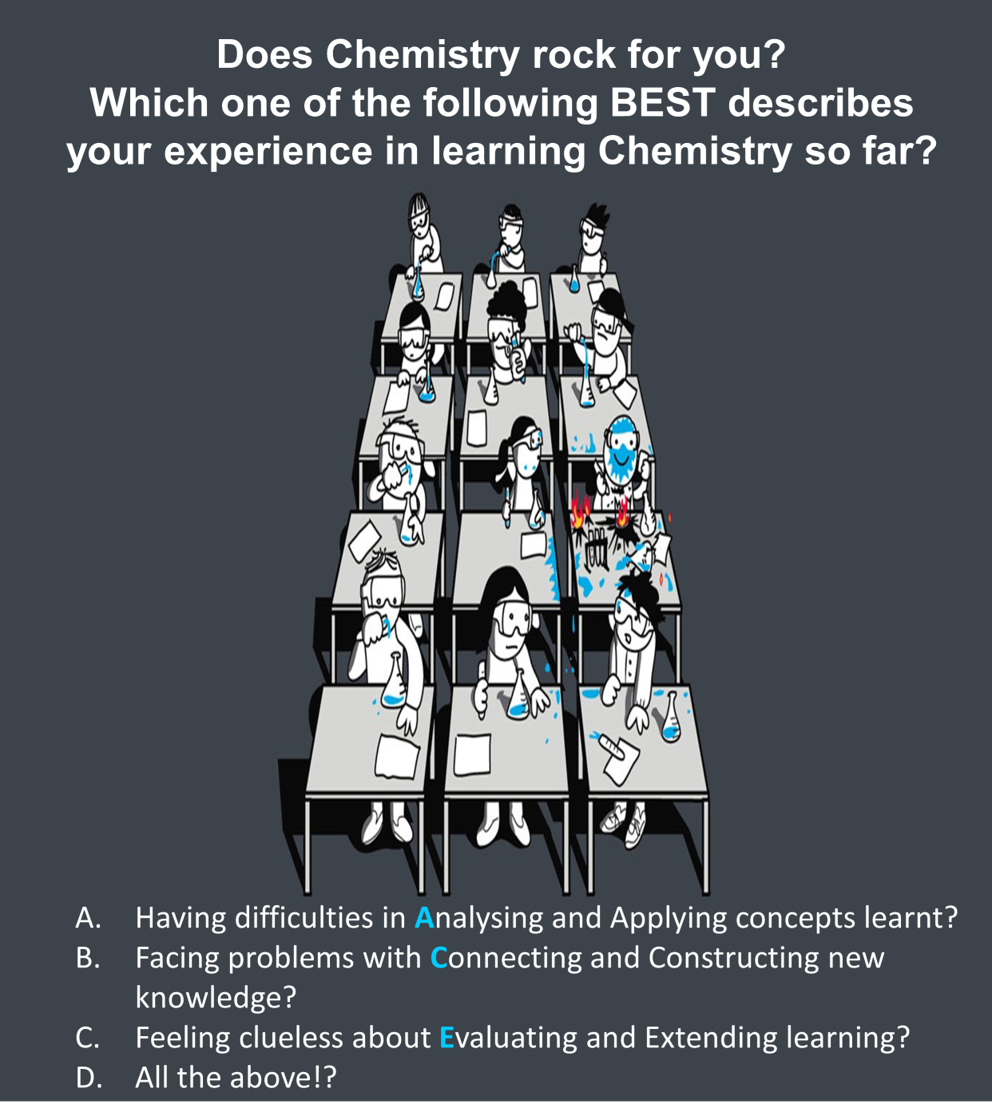
“If your answer is any of the above, MY CHEM CAFE® is the place to make Chemistry rock for you!”

Chemistry is also known as the “Central Science”. The study of Chemistry at ahigher
level such as ‘A’/IB requires a different skill set and approach from secondary level. At the post-secondary level, students encountered more complex topics and hence require a thorough understanding of concepts to be able to do well. Hence, students must develop the ability to break down a complex problem into simpler parts

At MY CHEM CAFE®, we aspire to equip our students with the ability to A.C.E. their Chemistry

APPLY CHEMISTRY CONCEPTS WITH CONFIDENCE

CONNECT THEORY WITH REAL-LIFE APPLICATIONS

EXTEND AND EXCEL IN LEARNING CHEMISTRY

MY CHEM CAFE WILL CEASE OPERATION FROM JULY 2025

Enquire

Level in 2025